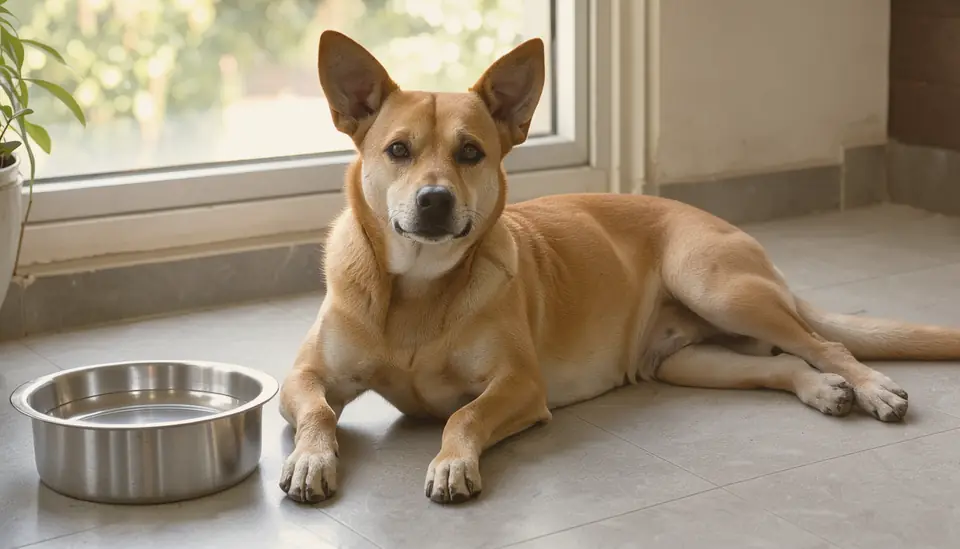
Measure a day’s drinking and compare it with the level vets treat as excessive for your pet’s weight. Never restrict water — a sudden change in thirst is the reason to call.
There is no “normal” level on this jug — no confirmed source gives one.
Talk to your vet. This is an estimate, not veterinary advice. Puppy Scale is not a veterinary practice and can’t examine your pet.
Estimate by Puppy Scale · sources checked Oct 7, 2026 · not veterinary advice · puppyscale.com
Measure a day’s drinking and compare it with the level vets treat as excessive for your pet’s weight. Never restrict water — a sudden change in thirst is the reason to call.
How the math works
Dogs
Drinking more than 90–100 mL a day per kg of body weight is what veterinary references call excessive (polydipsia). The band is that range × your dog’s weight.
One veterinary textbook treats more than 50 mL a day per kg as excessive for cats — a reason to talk to your vet; case reports describe more than 100 mL a day per kg as abnormal.
For context only: a typical total intake of about 50–60 mL a day per kg for dogs (food water included) is quoted from the NRC in peer-reviewed papers. It is not a target.
More than 90–100 mL a day per kg is too much: about 1,225–1,361 mL for a 30-lb dog
Why no source gives a normal daily amount, the 90–100 mL a day per kg vets treat as too much, how to measure 24-hour intake, and what differs for cats.
22-lb neutered dog: about 590 kcal a day (550–629); individual dogs 413–766
Why dog calorie calculators disagree: the resting-energy formula, AAHA and Merck factors, the WSAVA chart and a ±30% range, worked through for a 22-lb dog.