Weighed at about 18 months old in Sweden, Icelandic Sheepdog males average 34 lb (15.3 kg) and females 30 lb (13.4 kg). Males and females fall in different size classes, so their growth schedules differ a little (below).
Adult males
about 36 lbfrom 34 lb (15.3 kg) at 18 months, Swedish dogs
Adult females
about 31 lbfrom 30 lb (13.4 kg) at 18 months, Swedish dogs
Size class, males
Medium-large33–66 lb adults
Size class, females
Medium20–33 lb adults
90% grown, males
11 monthsat 48 weeks; 95% at 80 weeks
90% grown, females
13½ monthsat 58 weeks; 95% at 84 weeks
Weight by month
For a Icelandic Sheepdog puppy that grows into the breed’s measured weight: the most likely weight at each age, and under it the range the middle half of puppies of this size fall in.
Icelandic Sheepdog puppy weight by age, males and females, in pounds: the most likely weight and the middle half
Age
Males
Females
2 monthsearly estimate
6.8 lbmiddle half 5.6–8.2
7.2 lbmiddle half 5.9–8.5
3 months
11.1 lbmiddle half 9.6–12.8
11.1 lbmiddle half 9.5–12.8
4 months
16.2 lbmiddle half 14.4–18.2
15.6 lbmiddle half 13.8–17.6
5 months
21 lbmiddle half 18.5–23
18.9 lbmiddle half 17.0–21
6 months
25 lbmiddle half 22–27
22 lbmiddle half 20–24
7 months
27 lbmiddle half 25–29
24 lbmiddle half 22–26
8 months
29 lbmiddle half 27–32
25 lbmiddle half 23–28
9 months
31 lbmiddle half 28–33
27 lbmiddle half 25–29
10 months
31 lbmiddle half 29–34
28 lbmiddle half 25–30
11 months
32 lbmiddle half 30–34
28 lbmiddle half 26–30
1 year
32 lbmiddle half 30–34
28 lbmiddle half 26–30
15 months
33 lbmiddle half 32–35
29 lbmiddle half 27–31
18 months
34 lbmiddle half 32–35
30 lbmiddle half 28–31
Adult2–3 years, estimated
36 lb
31 lb
“Adult” is a dog’s weight at 2 to 3 years, as in the growth data the shares come from. The Swedish averages are set at 547 days of age, about 18 months, and the median medium-large puppy is at 95% of its adult weight by then — so the 18-month row is the Swedish figure itself and the adult row is that figure ÷ 0.949 (0.941 for females). Adults of a breed also differ from its average, so your puppy’s own path may sit higher or lower — the calculator below starts from your puppy’s weight instead. 2 months is an early estimate: the published growth charts start at 12 weeks.
The dashed line is the adult weight. The bands show how much puppies of one size differ in their growth pace at each age.
When growth slows and stops
Males
In our growth tables, half of medium-large puppies have reached 90% of their adult weight by 48 weeks (about 11 months) and 95% by 80 weeks (about 18½ months).
On the middle path a Icelandic Sheepdog male gains about 4.5 lb a month (2.0 kg) between 3 and 6 months, and about 0.2 lb a month (0.1 kg) between 1 year and 18 months.
Females
In our growth tables, half of medium puppies have reached 90% of their adult weight by 58 weeks (about 13½ months) and 95% by 84 weeks (about 19½ months).
On the middle path a Icelandic Sheepdog female gains about 3.7 lb a month (1.7 kg) between 3 and 6 months, and about 0.3 lb a month (0.1 kg) between 1 year and 18 months.
Merck’s veterinary manual says a less nutrient-dense diet than the growth diet is generally recommended once a dog has reached about 90% of its expected adult weight. It also says to feed for growth until skeletal maturity, which may not be complete until 10–16 months in large and giant breeds (8–12 months in small and medium ones) — so ask your vet before you switch to adult food. The puppy calendar puts that date, the weigh-ins and the vet-visit questions on your calendar. For amounts, use the puppy feeding calculator.
Your puppy’s own estimate
The table follows a puppy that ends at the breed figure. For your own puppy, enter its age and weight: the calculator uses the same growth data, with Icelandic Sheepdog preselected.
Puppy weight calculator
Example
A 16-week-old male Icelandic Sheepdog weighing 14.7 lb · medium-large size class
Your estimate · adult weight
about36lb
A 16-week-old male Icelandic Sheepdog weighing 14.7 lb will most likely weigh about 36 lb as an adult. Half of puppies like him end between 32 and 40 lb; 8 in 10 between 28 and 46 lb.
The size class differs by sex for this breed.
This breed’s figure is near the edge of a size class; pick a class if you know your dog’s family.
For Icelandic Sheepdogs the size class depends on the sex — this uses the males’ class.
Grown now
41%of adult weight
Growth curve used
Medium-large breedsthis class’s adults are 33–66 lb
The jug on the left shares the chart’s scale: full is the likely adult weight, so its level shows how much of it is already there (41%). Rings on the path mark where the median puppy of this size reaches 90% and 95% of adult weight.
A younger puppy at the same weight is headed for a bigger adult. Tap an age to use it above.
Where the size class came from
Icelandic Sheepdog males weigh about 34 lb as young adults, so the medium-large class (33–66 lb).
Young adults measured in Sweden: males 34 lb, females 30 lb — Andersson et al. (2023), Scientific Reports 13:443, CC BY 4.0
These figures are context: they pick the size class and never cap the estimate. Size classes for breeds the study lists: Salt et al. (2017), Table 1, CC BY 4.0. Kennel-club breed standard: see the club’s own Icelandic Sheepdog page.
Rules of thumb, tested on medium-large dogs
“Double the weight at 16 weeks”would say 29 lb for this puppy; in this data that rule runs 17% low for this size (median), and only 26% of dogs land within 10%.
“Double the weight at 4 months”in this data that rule runs 9% low for this size (median), and only 39% of dogs land within 10%.
“Double the weight at 6 months”in this data that rule runs 38% high for this size (median), and only 7% of dogs land within 10%.
Each rule checked against the real adult weights of thousands of dogs in the same data (derived from Salt et al. 2017, CC BY 4.0).
Talk to your vet. This is an estimate, not veterinary advice. Puppy Scale is not a veterinary practice and can’t examine your pet.
Estimate by Puppy Scale · sources checked Oct 7, 2026 · not veterinary advice · puppyscale.com
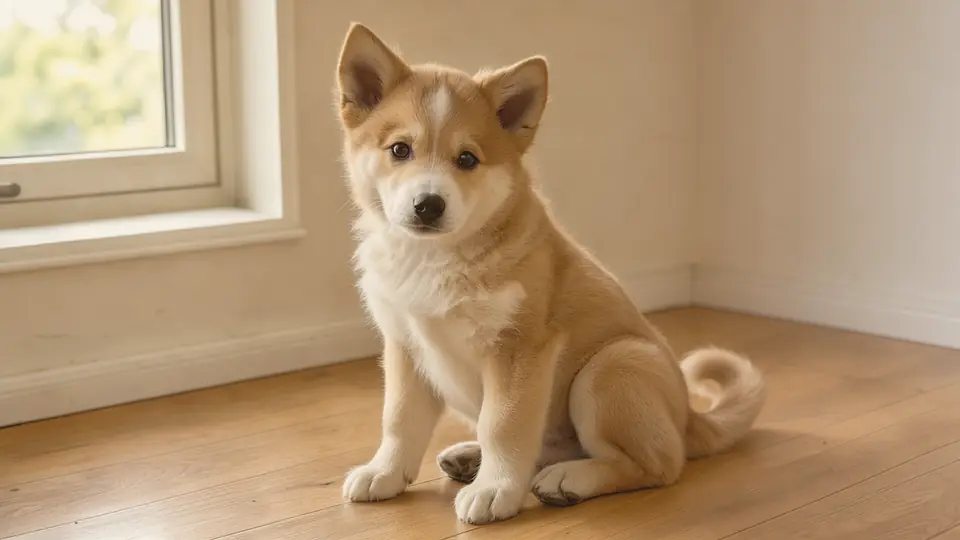
An AI-generated illustration of a Icelandic Sheepdog puppy, not a photo of a real dog.
Where these numbers come from
Males 34 lb (15.3 kg), females 30 lb (13.4 kg) — Swedish dogs weighed at hip screening at 12–24 months, the averages set at 547 days of age (91 males, 127 females). Andersson et al. (2023), Scientific Reports 13:443. Males are about 14% heavier.
At 34 lb (15.3 kg), Icelandic Sheepdog males fall in the medium-large size class (33–66 lb adults, 15–30 kg), so they follow that class’s growth pattern.
At 30 lb (13.4 kg), Icelandic Sheepdog females fall in the medium size class (20–33 lb adults, 9–15 kg), so they follow that class’s growth pattern.
More on how these numbers are worked out
The ages: each weight is the adult weight × the share of adult weight that the median puppy of the size class has reached at that age; the ranges use the 25th and 75th percentiles of that share. The shares are our summary of the open visit records behind Salt et al. (2017), a study of more than 6 million young dogs seen at U.S. veterinary hospitals; each share in this class comes from 543 to 2,530 dogs. Months are converted to weeks with 365.25 ÷ 12 days a month (17.4 weeks = 4 months), with straight lines between the measured ages.
Why one class’s pattern: the study found that growth “could be described using size categories rather than requiring curves for specific breeds” (Salt et al. 2017), so the whole breed follows its size class.
Kennel-club breed standard: see the club’s own Icelandic Sheepdog page. We store no kennel-club data.
Breed sources checked October 24, 2026: Salt et al. 2017, Andersson et al. 2023, Merck. All numbers are in Data and sources; the share tables are on Puppy growth standards.
What this doesn’t cover
A growth standard for this breed alone: Not modeled— there is no openly licensed month-by-month growth standard for single breeds; the size class’s pattern is used (checked October 24, 2026).
How much adults of this breed vary: Not modeled— the studies publish an average or median, not a spread, so the ranges show differences in growth pace only (checked October 24, 2026).
Before 8 weeks and after 18 months: Not modeled— our growth tables cover 8 to 78 weeks (checked October 24, 2026).
Neutering, height and paw size: Not modeled— none is an input; the growth study found neutering’s effect small next to the differences between dogs (checked October 24, 2026).
Growth bands derived by Puppy Scale from Salt C et al. (2017), PLOS ONE 12(9):e0182064, data: Salt C, Morris PJ, German A, Wilson D, Lund EM, Cole TJ, Butterwick RF (2017), “Growth standard charts for monitoring bodyweight in dogs of different sizes – SUPPORTING DATA”, University of Liverpool DataCat 377, licensed CC BY 4.0. Our tables are empirical summaries, not the published model curves. Changes: see the method.
Breed weights: Andersson L et al. (2023) Scientific Reports 13:443 (CC BY 4.0); Bannasch D et al. (2021) Canine Medicine and Genetics 8:12 (CC BY 4.0); O’Neill DG et al. (2023) PLOS ONE 18(7):e0288081 and (2026) Companion Animal Health and Genetics 13:4, VetCompass UK (CC BY 4.0); Hayward JJ et al. (2016) Nature Communications (CC BY 4.0). Kennel-club breed standards: see the club’s own breed page.